
Every blogger, freelancer, and content creator knows the feeling staring at a blank page while the cursor blinks and the deadline gets closer.
Thank you for reading this post, don't forget to subscribe!The problem is not creativity. It is efficiency.
In 2026, the best AI tools for content writing free have completely changed how content is created. What once took hours can now be done in minutes without sacrificing quality, originality, or your unique voice.
Whether you are writing blog posts, SEO articles, product descriptions, or social media content, these tools help you generate ideas faster, write smarter, and publish high-quality content consistently. Instead of replacing you, AI works as your assistant, helping you overcome writer’s block, improve structure, and optimize for search engines.
In this guide, you will discover the 15 best free AI tools for content writing in 2026, how they compare, and how to use them to boost productivity, improve rankings, and create high-performing content.
What Are AI Content Writing Tools
AI content writing tools are software applications that use large language models to help users generate, edit, and optimise written content. You give the tool a prompt, a topic, or a brief, and it produces a draft, a headline, an outline, or a full article based on your input.
The best ones go beyond simple text generation. They understand tone, structure, SEO requirements, and audience intent. In 2026, free AI writing tools have become sophisticated enough to handle everything from blog introductions to full marketing campaigns.
Why Use Free AI Writing Tools
The case for using AI writing tools is straightforward:
- They dramatically cut the time it takes to produce a first draft
- They eliminate writer’s block by giving you a starting point immediately
- They help non-native English speakers write polished, professional content
- They suggest ideas, angles, and structures you might never have considered
- They make consistent content publishing possible even with a small team or solo operation
For bloggers and small businesses, especially, free AI tools level the playing field against larger content operations with bigger budgets.
Who Should Use AI Writing Tools
These tools are built for a wide range of users:
- Bloggers who need to publish consistently without burning out
- Freelance writers who want to work faster and take on more clients
- Digital marketers creating ad copy, email campaigns, and landing pages
- Small business owners who handle their own website content
- SEO specialists who need keyword-rich content at scale
- Social media managers write captions, threads, and posts daily
If you create content in any form, there is a free AI writing assistant on this list for you.
Best AI Tools for Content Writing Free in 2026
These are the tools that actually deliver tested, trusted, and used by content creators worldwide.
ChatGPT – Best Free AI Writing Assistant
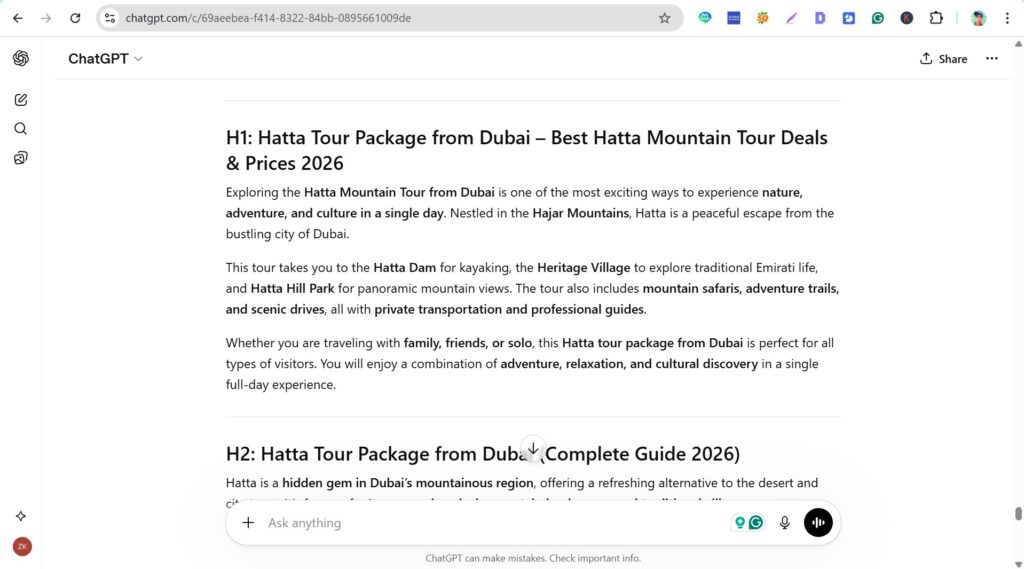
ChatGPT remains the most powerful and versatile free AI writing tool in 2026. It handles virtually every content format: blog posts, outlines, product descriptions, email sequences, ad copy, social media content, and more.
What makes ChatGPT stand apart is how well it adapts to your instructions. The more specific your prompt, the better your output. Ask it to write in a conversational tone, adopt a specific brand voice, target a particular audience, or follow a defined structure — and it delivers.
Free plan: Yes — GPT-4o included in the free tier in 2026.
Best for: All-purpose content creation, blog writing, copywriting, and brainstorming.
Standout feature: Handles any content format and adapts to virtually any writing style or instruction.
Limitation: No built-in SEO integration on the free plan — you need to manually optimize for keywords.
Copy.ai – Best for Marketing Content
Copy.ai was built specifically for marketers and copywriters, and it shows. Where ChatGPT is a generalist, Copy.ai is a specialist. It comes loaded with pre-built templates for:
- Facebook and Google ad copy
- Product descriptions
- Email subject lines
- Sales page headlines
- Instagram captions
- Website hero text
The free plan is genuinely useful — it gives you access to the core templates and a monthly word limit that works well for light-to-moderate content needs.
Free plan: Yes — includes 2,000 free words per month and access to 90+ templates.
Best for: Marketers, e-commerce businesses, and social media managers who need short-form copy fast.
Standout feature: Marketing-specific templates that produce conversion-optimised copy with minimal input.
Writesonic – Best for Blog Writing
Writesonic is one of the most blog-focused AI content writing tools available, and its free tier is surprisingly capable. It specialises in long-form content and comes with a built-in article writer that can generate a full blog post from a title and a few keywords.
In 2026, Writesonic also integrates with Google Search data to help align your content with what people are actually searching for — a significant advantage for SEO content writing.
Free plan: Yes — limited article generations per month, with access to core features.
Best for: Bloggers and content marketers who need full-length, SEO-aware blog posts.
Standout feature: Long-form article builder with real-time SEO suggestions.
Rytr – Best Budget-Friendly AI Tool
Rytr is the most accessible free AI writing tool on this list. It has a generous free plan, a clean interface, and covers over 40 content use cases — from blog sections and SEO meta descriptions to story plots and job descriptions.
For beginners who are just getting started with AI-assisted writing, Rytr is the easiest entry point. There is no steep learning curve, no overwhelming feature set — just a simple tool that helps you write more, faster.
Free plan: Yes — 10,000 characters per month free, no credit card required.
Best for: Beginners, solo bloggers, and freelancers who need a simple, reliable writing assistant.
Standout feature: 40+ use cases covered in one tool with a genuinely usable free tier.
Grammarly – Best for Editing & Clarity
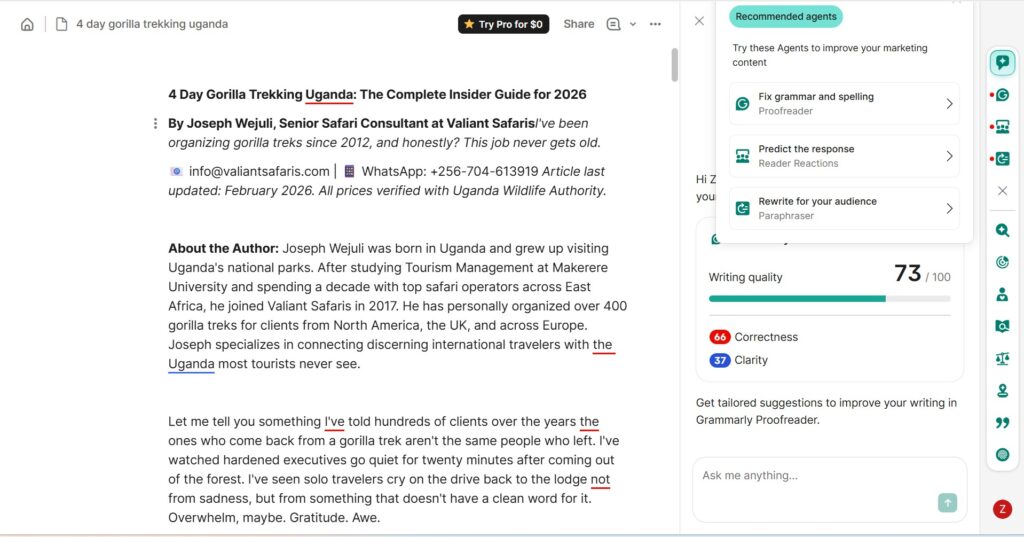
Grammarly is the final, non-negotiable layer in any serious content writing workflow. It is not a content generator — it is an AI-powered editor that ensures everything you write (or everything your AI tool generates) is clear, grammatically correct, and professional.
In 2026, Grammarly’s free version includes:
- Real-time grammar and spelling correction
- Clarity and conciseness suggestions
- Tone detection
- Basic plagiarism checking
Every piece of content — whether you wrote it yourself or generated it with ChatGPT should pass through Grammarly before it goes live.
Free plan: Yes — core editing features are completely free.
Best for: Editing and polishing all content before publishing.
Standout feature: Works inside Google Docs, WordPress, email clients, and your browser — everywhere you write.
AI Tools for Content Writing Free for Bloggers & SEO
If you run a blog or manage content for SEO purposes, these tools deserve a specific look.
Tools for Blog Post Writing
For full blog posts, Writesonic and ChatGPT are the strongest free options. Writesonic’s article builder is purpose-built for long-form content. ChatGPT is better for blog content that requires specific tone control, niche expertise, or creative angles.
A strong workflow: use ChatGPT to generate your outline and intro, Writesonic to flesh out the body sections, and Grammarly to clean everything up before publishing.
Tools for SEO Content Optimisation
For SEO content writing, you need tools that understand keyword placement, heading structure, and search intent. Writesonic’s SEO integration gives it an edge here. ChatGPT can be prompted to write with a target keyword in mind — specify your focus keyword in the prompt, ask for it in the H1, intro, and two to three H2S, and it will follow through.
Grammarly’s clarity improvements also indirectly help SEO — cleaner sentences reduce bounce rate and improve time on page.
Tools for Keyword-Based Content Creation
When building keyword-based content at scale — think topical clusters, pillar pages, or a month’s worth of blog posts — Rytr’s bulk-friendly free plan and Copy.ai’s template system work well together. Map out your keyword list, use Rytr or Copy.ai to generate section content, and layer in your own expertise and examples.
The key with blog writing automation is to treat AI as the scaffolding and your knowledge as the structure. The best-ranking content combines AI efficiency with genuine human insight.
Features to Look for in AI Tools for Content Writing Free
Not all free AI writing tools are equal. Here is what separates the good ones from the mediocre ones.
Content Quality & Accuracy
A free tool that produces generic, repetitive, or factually inaccurate content is worse than useless — it wastes your time and damages your credibility. Look for tools that produce coherent, naturally flowing text with accurate information. Always verify facts before publishing, regardless of which tool you use.
SEO Optimisation Features
The best AI copywriting tools free are built with SEO in mind. Look for tools that allow keyword input, generate SEO meta descriptions, and structure content with proper headings. Writesonic and ChatGPT both allow direct keyword targeting within your prompts.
Ease of Use
The best tool for you is one you will actually use consistently. If an interface feels complicated or produces too much friction, you will abandon it. Grammarly and Rytr are the easiest to start with. ChatGPT requires prompt practice but rewards that investment quickly.
Free Plan Limitations
Every free plan has limits — word counts, generation limits, or feature restrictions. Understand your content volume before choosing a tool. For light bloggers (two to four posts per month), most free tiers are sufficient. For heavy publishers, you may need to combine two or three free tools to stay within limits.
Comparison of Best Free AI Content Writing Tools
| Tool | Best For | Free Plan | Word Limit | SEO Features | Ease of Use |
|---|---|---|---|---|---|
| ChatGPT | All-purpose writing | Yes | Generous | Manual | ⭐⭐⭐⭐⭐ |
| Copy.ai | Marketing copy | Yes | 2,000/month | Basic | ⭐⭐⭐⭐⭐ |
| Writesonic | Blog writing | Yes | Limited | Built-in | ⭐⭐⭐⭐ |
| Rytr | Beginner-friendly | Yes | 10,000 chars | Basic | ⭐⭐⭐⭐⭐ |
| Grammarly | Editing & clarity | Yes | Unlimited | Indirect | ⭐⭐⭐⭐⭐ |
Pros and Cons of Free AI Writing Tools
Advantages of Using AI Tools
- Speed — Draft content in minutes instead of hours
- Consistency — Publish regularly without burning out or losing quality
- Cost — Build a full content workflow with zero upfront investment
- Variety — Cover multiple content formats with a single tool
- Accessibility — Non-native English speakers can produce professional-quality content
- Scalability — Create more content without hiring additional writers
- Creativity boost — AI suggestions often spark ideas you would not have thought of alone
Limitations of Free Tools
- Word and generation limits — Free plans restrict how much you can produce monthly
- Generic output — Without strong prompts, AI content can feel bland and impersonal
- Factual errors — AI tools sometimes produce confidently incorrect information
- No real expertise — AI cannot replicate first-hand experience, case studies, or original research
- SEO gaps — Most free tools require manual SEO optimisation
- Plagiarism risk — Always run AI content through a plagiarism checker before publishing
- Over-reliance — Content that is entirely AI-generated with no human input rarely ranks well long-term
How to Choose the Best AI Tools for Content Writing Free
Based on Your Content Needs
Start by identifying your primary content format. If you write long blog posts, Writesonic or ChatGPT are your best starting points. If you need short marketing copy, go with Copy.ai. If you just want a reliable writing assistant for any task, ChatGPT is the default choice.
Based on Budget (Free vs Paid)
All five tools on this list have usable free plans. Before paying for any upgrade, spend two to four weeks on the free tier and honestly assess whether you are hitting the limits regularly. Most solo bloggers and freelancers never need to upgrade beyond free for their core workflow.
If you do hit limits, upgrading one primary tool (like Writesonic for blogs or Copy.ai for marketing) is more efficient than spreading budget across multiple partial upgrades.
Based on Writing Style
Different tools have different default writing styles. ChatGPT is highly adaptable and mimics whatever style you specify. Copy.ai leans marketing-heavy and persuasive. Writesonic defaults to a structured, informational blog tone. Rytr is clean and neutral.
Try the same prompt in two different tools and see which output feels closer to your natural voice. That is usually your best long-term match.
Tips to Use AI Tools for Content Writing Effectively
Combine AI with Human Editing
AI should be the engine of your first draft, not the final word. Always read through, rewrite flat sections, add your own opinions, and inject examples from your own experience. Content that blends AI efficiency with a genuine human perspective consistently outperforms fully automated output.
Google’s helpful content systems reward content that demonstrates real expertise, first-hand experience, and genuine value. A polished AI draft with your personal insight added is significantly stronger than a raw AI output published as-is.
Use AI for Ideas, Not Just Writing
One of the most underused applications of free AI writing tools is idea generation. Use ChatGPT or Copy.ai to brainstorm 20 blog post ideas in your niche, generate ten different headline variations for your next post, or suggest angles you had not considered.
Content generation does not always mean writing — sometimes the most valuable output is a list of ideas that sparks a month’s worth of original content.
Optimise Content for SEO
AI tools do not automatically produce SEO-optimised content — you have to guide them. When prompting any AI tool, specify:
- Your target primary keyword
- Where to include it (title, first paragraph, two to three subheadings)
- Desired content length
- Audience level (beginner, intermediate, expert)
- Tone (informational, conversational, authoritative)
With this level of direction, even a free plan on any of these tools can produce plagiarism-free content that is structured for search visibility from the first draft.
FAQs – AI Tools for Content Writing Free
Are free AI writing tools good for SEO?
Yes — when used correctly. Tools like Writesonic have built-in SEO features, and ChatGPT can be prompted to target specific keywords and follow SEO-friendly heading structures. However, free tools alone are not enough. You still need to do keyword research, optimise your meta descriptions, build internal links, and ensure your content genuinely answers the reader’s question. AI handles the writing — SEO strategy still requires human judgment.
Which AI tool is best for blog writing?
For full-length blog posts, Writesonic and ChatGPT are the strongest free options in 2026. Writesonic’s long-form article builder is specifically designed for blog content with SEO in mind. ChatGPT offers more flexibility and style control. Many experienced bloggers use both ChatGPT for ideation and structure, Writesonic for filling out sections at speed.
Can AI tools replace human writers?
No, and the best AI tools are not designed to. AI tools are writing assistants, not replacements. They are excellent at generating drafts, overcoming writer’s block, and handling repetitive content tasks. But they cannot replicate personal experience, original research, unique brand voice, or the kind of nuanced expertise that makes content genuinely trustworthy and valuable. Human oversight is not optional — it is what separates good content from content that ranks and builds an audience.
Are free AI tools safe to use?
The tools listed in this guide — ChatGPT, Copy.ai, Writesonic, Rytr, and Grammarly — are reputable, widely used, and safe for general content creation purposes. Standard precautions apply: do not enter sensitive personal data, confidential client information, or private business details into any third-party AI platform. Review each tool’s privacy policy if data handling is a concern for your use case.
Conclusion – Best Free AI Writing Tool for You
The best AI tools for content writing free in 2026 have removed the biggest obstacle most content creators face: the gap between having an idea and having a finished piece.
Here is a quick decision guide:
- If you want one tool to do everything → ChatGPT
- If you write marketing copy and ads → Copy.ai
- If you focus on long-form blog content → Writesonic
- If you want the easiest free tool → Rytr
- If you need editing and polishing → Grammarly (use it with everything else)
The smartest approach is not to choose just one. Build a simple stack: ChatGPT for drafting and ideation, Grammarly for editing, and one specialist tool (Writesonic or Copy.ai) for your primary content format. Together, they cover the full content creation pipeline — completely free.
Stop waiting for the perfect moment to start publishing. Pick your tool, write your first draft today, and refine as you go. That is how content creators who rank are actually working in 2026.
Looking for more smart tech and productivity tools? Read more expert guides on Cognetify — your trusted source for digital insights in 2026.

- Best Futures Position Size Calculator: Calculate Trading Risk - October 23, 2026
- How to Use Canva: 7 Easy Steps for Beginners - October 19, 2026
- How Much Is DEF Per Gallon in 2026? Best Prices & Savings - October 16, 2026