
You have heard everyone talking about AI. Your colleagues are using it. Creators online are building entire businesses with it. And you are sitting there thinking — where do I even start?
Thank you for reading this post, don't forget to subscribe!Here is the good news: you do not need a computer science degree, a tech background, or a single line of code to start using AI tools today. The best AI tools for beginners in 2026 are designed to be intuitive, accessible, and genuinely useful from the very first minute you open them.
This guide covers exactly what you need to know — what these tools are, which ones are worth your time, and how to start using them right now without feeling overwhelmed.
Whether you want to write better, design faster, stay organized, or simply understand what all the AI fuss is about, there is a beginner-friendly tool in this list for you.
What Are AI Tools for Beginners
AI tools for beginners are software applications powered by artificial intelligence that are specifically built — or adapted — for people with no technical background. They use a simple input (usually plain text or a button click) to produce useful outputs like written content, images, summaries, designs, or organized tasks.
You do not configure algorithms. You do not write code. You type what you want, and the tool does the rest.
Why Beginners Should Use AI Tools
The barrier to entry for AI has never been lower. In 2026, the most powerful AI tools in the world will be available through a browser tab, cost nothing to start, and require zero technical knowledge.
Beginners who start using AI tools early build a genuine competitive advantage — in their careers, creative work, and personal productivity. The people who wait to “learn more before starting” consistently fall behind those who just start and learn as they go.
Who Can Use Beginner AI Tools
The short answer is everyone. More specifically:
- Students are learning how to research and write
- Freelancers starting out in writing, design, or marketing
- Small business owners managing content and operations solo
- Professionals who want to work faster and smarter
- Creators building blogs, YouTube channels, or social media presence
- Anyone who is simply curious about artificial intelligence and wants to explore it practically
Why AI Tools Are Important for Beginners in 2026
AI is no longer a future trend — it is the present standard. Here is why getting started now matters.
Save Time with Automation
The most immediate benefit of automation tools for beginners is time. Tasks that used to take hours — drafting an email, designing a graphic, summarizing a document, creating a presentation — now take minutes.
For someone just building a freelance career, a blog, or a side project, that time saving is the difference between getting things done and burning out trying to do everything manually.
Improve Productivity
AI productivity tools do not just speed things up — they improve the quality of your output. A beginner writer using Grammarly produces cleaner copy than an intermediate writer who does not. A first-time designer using Canva AI creates polished visuals that would have taken hours to produce from scratch.
AI removes the ceiling on what beginners can produce, letting skill and ambition — not technical knowledge — determine the outcome.
Learn AI Without Coding
One of the biggest misconceptions about AI is that you need to understand how it works to use it. You do not — just like you do not need to understand combustion engines to drive a car.
The best no-coding AI tools in 2026 are built around natural language interfaces. You talk to them, type to them, or click through guided workflows. Learning AI basics happens naturally as you use these tools — not from a textbook.
Best AI Tools for Beginners in 2026
These six tools cover the most important areas of beginner AI use — writing, design, productivity, content creation, and video. Every one of them is accessible without any technical background.
ChatGPT – Best AI Tool for Beginners Overall
If you only ever try one AI tool, make it ChatGPT. It is the most versatile, the most widely used, and arguably the easiest to understand because the interface is simply a chat window.
You type a question, a request, or an instruction — and ChatGPT responds. That is it.
For beginners, ChatGPT handles:
- Answering questions on any topic
- Drafting emails, essays, and messages
- Explaining complex topics in simple terms
- Brainstorming ideas for projects, content, or business
- Summarizing long documents or articles
- Helping with basic coding, math, or research
Free plan: Yes — GPT-4o available on the free tier in 2026.
Why it is perfect for beginners: No setup, no learning curve, no technical knowledge required. If you can type, you can use ChatGPT.
Canva AI – Best for Design Beginners
Design used to require years of practice and expensive software. Canva changed that, and Canva AI has taken it a step further.
With Canva’s AI-powered features, complete design beginners can:
- Generate social media graphics from a text description
- Create professional presentations automatically
- Remove image backgrounds with one click
- Resize designs for any platform instantly
- Generate AI art and visuals to use in projects
The interface is drag-and-drop, the templates are beautiful, and the AI features are woven in naturally so you do not even have to think about “using AI” — you just use Canva, and it happens.
Free plan: Yes — generous free tier with access to most core AI features.
Why it is perfect for beginners: You do not need design skills. You need an idea, and Canva does the rest.
Grammarly – Best for Writing Beginners
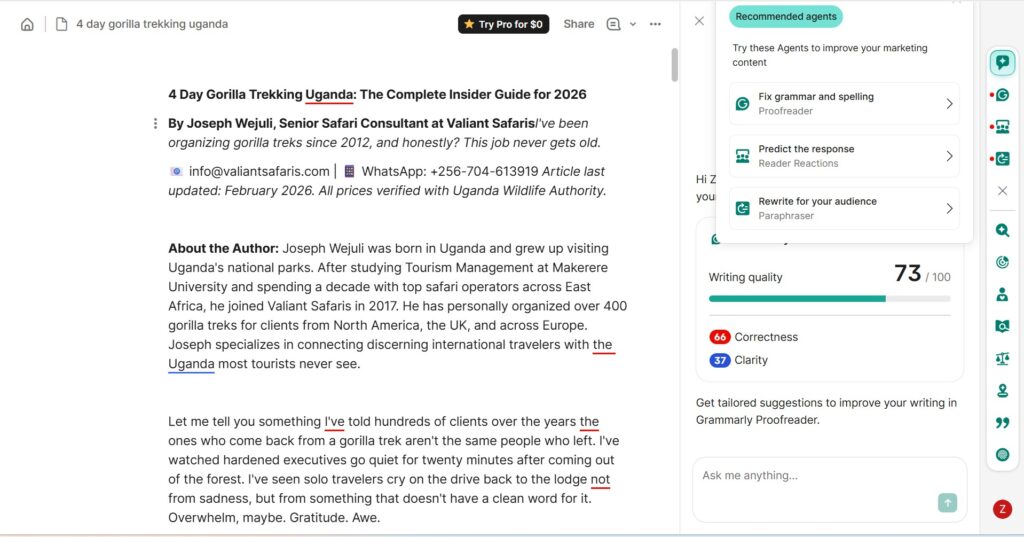
For anyone who writes — which is almost everyone — Grammarly is the most immediately impactful free AI tool available. It works silently in the background of every text box you use and fixes your grammar, improves your clarity, and adjusts your tone in real time.
Beginners benefit from Grammarly in two ways: their writing quality improves immediately, and over time, they learn from the corrections and stop making the same mistakes.
Free plan: Yes — core grammar, spelling, and clarity features are completely free.
Why it is perfect for beginners: It works inside Gmail, Google Docs, Microsoft Word, and your browser. There is no separate app to learn — it comes to you.
Notion AI – Best for Productivity
Notion is one of the most popular organization apps in the world, and Notion AI makes it even more powerful without adding complexity. For beginners who feel disorganized — juggling tasks, notes, projects, and ideas across different apps — Notion gives you one place for everything.
Notion AI adds:
- Automatic summarization of your notes
- AI-generated to-do lists from messy brainstorming
- Instant content drafts from simple prompts
- Smart organization of projects and tasks
Free plan: Yes — Notion has a free personal plan with basic AI features included.
Why it is perfect for beginners: It replaces five different apps (notes, tasks, calendar, docs, and a knowledge base) with one clean workspace, then adds AI on top.
Copy.ai – Best for Content Creation
For beginners who want to create content for a blog, social media, or marketing — but do not know where to start — Copy.ai is the most template-driven, beginner-friendly AI content tool available.
Instead of writing long prompts, you pick a template (Instagram caption, blog intro, product description, email subject line) and fill in a few simple fields. Copy.ai generates ready-to-use copy in seconds.
Free plan: Yes — 2,000 words per month and 90+ templates available free.
Why it is perfect for beginners: Templates remove the guesswork. You do not need to know how to prompt AI — you just fill in the blanks.
Pictory AI – Best for Video Creation
Video content is one of the most powerful formats online — and it used to require great technical skills. Pictory AI changes that entirely for beginners.
You paste a blog post, a script, or a text summary — and Pictory automatically creates a short video with matching visuals, captions, and background music. No video editing experience needed.
Free plan: Yes — limited video generations per month on the free tier.
Why it is perfect for beginners: You start with text (something anyone can write) and end with a polished video — with nothing in between but a few clicks.
Best AI Tools for Beginners Free Options
Free AI Tools with No Cost
Several of the most capable AI tools are completely free to start with no credit card required. ChatGPT, Grammarly, Canva AI, and Copy.ai all offer genuine, functional free plans — not stripped-down demos, but real tools with real value.
For a beginner building their first AI toolkit, these four tools alone cover writing, editing, design, and content creation at zero cost.
Freemium Tools with Upgrade Options
Most beginner AI tools follow a freemium model — free to start, with paid plans that unlock higher limits or advanced features. Notion AI, Writesonic, Pictory, and Rytr all fall into this category.
The strategy: start free, use the tool for 30 days, and only upgrade if you consistently hit the free plan limits. Most beginners never need to.
Limitations of Free Plans
Free plans have real limitations worth knowing before you start:
- Monthly word or generation caps (Copy.ai gives 2,000 words/month free)
- Limited access to advanced AI models or features
- Watermarks on some designs and video outputs (Canva, Pictory)
- Storage limits on free Notion plans
- Slower processing speeds on free tiers during peak hours
None of these limitations is a dealbreaker for beginners. They become relevant as your usage grows — which is exactly when upgrading makes financial sense.
Features to Look for in the Best AI Tools for Beginners
Easy Interface
The best beginner-friendly interface tools are ones you can figure out in under five minutes without watching a tutorial. Look for tools with clean layouts, clear labels, and guided workflows. ChatGPT, Grammarly, and Canva are the gold standard here.
No Coding Required
Every tool on this list requires zero coding knowledge. If a tool requires API setup, terminal commands, or technical configuration to get started, it is not a beginner tool — skip it for now and come back later when you have more experience.
Free Access
AI tools for beginners with free plans are widely available in 2026. There is no reason to pay for any AI tool before you have tested whether it fits your workflow. All six tools recommended in this guide have usable free tiers.
Multi-Use Functionality
The best beginner tools are ones you can use across multiple tasks. ChatGPT and Notion AI both qualify — they are not single-purpose apps. A tool you use every day across five different tasks delivers far more value than five separate single-purpose tools you log into once a week.
Comparison of Best AI Tools for Beginners
| Tool | Best For | Free Plan | Coding Required | Ease of Use | Best Beginner Feature |
|---|---|---|---|---|---|
| ChatGPT | All-purpose AI assistant | Yes | No | ⭐⭐⭐⭐⭐ | Chat-based, works for anything |
| Canva AI | Design & visuals | Yes | No | ⭐⭐⭐⭐⭐ | Drag-and-drop AI design |
| Grammarly | Writing & editing | Yes | No | ⭐⭐⭐⭐⭐ | Auto-corrects everywhere you type |
| Notion AI | Productivity & notes | Yes | No | ⭐⭐⭐⭐ | All-in-one workspace with AI |
| Copy.ai | Content & marketing | Yes | No | ⭐⭐⭐⭐⭐ | Ready-made templates |
| Pictory AI | Video creation | Limited | No | ⭐⭐⭐⭐ | Text-to-video automation |
How to Choose the Best AI Tool for Beginners
Based on Your Goals
The right tool depends entirely on what you are trying to achieve:
- Want to write better? → Grammarly + ChatGPT
- Want to create content for social media or a blog? → Copy.ai + Canva AI
- Want to stay organized and productive? → Notion AI
- Want to make video content without experience? → Pictory AI
- Want one tool that does everything? → ChatGPT
Do not try to use all six at once. Pick one or two that match your immediate goal and start there.
Based on Skill Level
Total beginner with no AI experience at all? Start with Grammarly — it requires no deliberate learning and delivers value immediately inside the tools you already use.
Ready to try something more hands-on? Move to ChatGPT next. It has the most learning potential of any free AI tool and rewards the time you put into understanding how to prompt it well.
Based on the budget
Every tool on this list has a usable free plan, so budget is not a barrier at the start. As you build comfort with AI tools and start generating real output, consider upgrading the one or two tools you use most heavily. That targeted investment delivers far more value than spreading a small budget across multiple partial upgrades.
Pros and Cons of AI Tools for Beginners
Advantages of Using AI Tools
- Instant productivity gains — results from day one, no training period
- Removes intimidation — modern AI tools are built to be accessible and encouraging
- Levels the playing field — beginners produce professional-quality output with the right tools
- Continuous improvement — the more you use these tools, the better your prompts and outputs become
- Completely free to start — no financial risk in testing any tool on this list
- Wide range of applications — writing, design, video, productivity, and research all covered
Limitations for Beginners
- Output quality depends on input quality — vague prompts produce vague results
- Risk of over-dependence — relying too heavily on AI can slow the development of your own skills
- Accuracy is not guaranteed — AI tools can produce confident but incorrect information
- Free plan restrictions — heavy users will hit limits and need to manage usage carefully
- Learning curve for prompting — getting the best results from ChatGPT takes practice
Tips for Beginners to Use AI Tools Effectively
Start with Simple Tools
Do not start with the most complex or feature-rich AI platform you can find. Start with the one that solves your most immediate problem with the least friction. Grammarly for writing. Canva for design. ChatGPT for questions. Build from there.
Practice Daily
The single biggest factor in how quickly you become comfortable with AI tools is consistency. Even five to ten minutes of daily use — asking ChatGPT a question, running a draft through Grammarly, or generating a social post in Copy.ai — builds genuine skill and comfort faster than any course or tutorial.
Combine Multiple AI Tools
The most effective beginners do not rely on a single AI tool — they build a simple stack. A practical beginner stack might look like: ChatGPT to draft content, Grammarly to edit it, and Canva AI to design visuals around it. Each tool covers a different part of the workflow, and together they produce a polished final result.
Common Mistakes Beginners Make with AI Tools
Over-Reliance on AI
The most common beginner mistake is treating AI output as finished work. It is not. AI tools are powerful first-draft generators and assistants — but the final product always needs your review, your perspective, and your judgment. Content, designs, or decisions published without any human oversight will eventually produce errors that damage your credibility.
Not Verifying Output
AI tools can be confidently wrong. ChatGPT in particular sometimes produces statistics, quotes, or facts that sound authoritative but are inaccurate. Always verify specific factual claims through a reliable source before using them in anything public. This habit takes seconds and prevents potentially serious mistakes.
Ignoring the Learning Process
Some beginners use AI tools purely for output and never pay attention to why the tool responded the way it did. This is a missed opportunity. The fastest way to get better at using AI is to treat each interaction as a small experiment — notice what prompts worked, what did not, and adjust. Learning AI basics does not require a course. It requires curiosity and attention.
FAQs – Best AI Tools for Beginners
What is the best AI tool for beginners?
ChatGPT is the best overall AI tool for beginners in 2026. It works through a simple chat interface, requires no technical setup, handles virtually any task you throw at it, and is free to use. For writing specifically, combining ChatGPT with Grammarly gives beginners an immediate and noticeable improvement in their output.
Are AI tools free for beginners?
Yes — most of the best AI tools for beginners have genuinely useful free plans. ChatGPT, Grammarly, Canva AI, Copy.ai, and Notion AI all offer free tiers that are more than sufficient for beginners getting started. You can build a complete beginner AI toolkit without spending anything.
Do I need coding skills to use AI tools?
No. Every tool recommended in this guide requires zero coding knowledge. The best beginner AI tools are built around plain language interfaces — you type what you want in normal English, and the tool does the technical work invisibly. No coding AI tools are the standard in 2026, not the exception.
Which AI tool is easiest to use?
Grammarly is arguably the easiest AI tool to start with because it requires no deliberate interaction — it works automatically in the background of whatever you are writing. For tools you actively engage with, ChatGPT and Canva AI both have exceptionally clean, intuitive interfaces that beginners consistently describe as easy to understand from the first session.
Conclusion – Which AI Tool Should Beginners Start With?

The best AI tools for beginners in 2026 are more accessible, more powerful, and freer than ever before. There has never been a better time to start.
Here is your simple starting plan:
- Day 1: Install Grammarly — instant value, zero effort
- Day 2: Open ChatGPT and ask it something you genuinely want to know
- Day 3: Try Canva AI for a design, Copy.ai for a social post, or Notion for your tasks
You do not need to master everything at once. You just need to start. The learning happens naturally through use — and the results are immediate.
AI will not do the work for you. But it will make everything you do faster, cleaner, and more professional. For a beginner, that is an extraordinary advantage.
The only mistake is waiting.
Want more beginner-friendly tech and productivity guides? Explore everything on Cognetify — smart digital insights for 2026 and beyond.

- Best Futures Position Size Calculator: Calculate Trading Risk - October 23, 2026
- How to Use Canva: 7 Easy Steps for Beginners - October 19, 2026
- How Much Is DEF Per Gallon in 2026? Best Prices & Savings - October 16, 2026