
A Futures Position Size Calculator helps traders determine how many futures contracts they can trade based on their account balance, acceptable risk, and stop-loss distance. Instead of guessing how large a position should be, you can use a simple calculation to estimate your potential loss before entering a trade.
Thank you for reading this post, don't forget to subscribe!Futures markets can move quickly, and even a small price movement can create a significant profit or loss when leverage is involved. Choosing the right position size helps you manage that risk while keeping your trading decisions consistent.
Whether you trade E-mini S&P 500 (ES), Micro E-mini S&P 500 (MES), Nasdaq futures (NQ), or Micro E-mini Nasdaq-100 (MNQ), understanding position sizing is an important part of a disciplined trading plan.
In this guide, you will learn how to use a futures position size calculator, understand the position sizing formula, calculate risk per contract, compare different futures contracts, and avoid common mistakes that can affect your trading account.
How to Use This Futures Position Size Calculator
Using a futures position size calculator is straightforward once you understand the information required. The goal is to estimate a suitable contract quantity based on your planned risk rather than choosing a position size based on potential profits alone.
Step 1: Enter Your Trading Account Balance
Start by entering the amount of capital in your trading account that you use for your calculations. For example, if your trading account contains $10,000, use that amount as your starting balance.
Your account balance helps determine how much money you are willing to risk on a single trade. However, the full account balance is not the amount you should automatically risk.
Step 2: Choose Your Risk Per Trade
Decide how much of your account you are prepared to lose if the trade reaches your stop-loss.
For example, a trader with a $10,000 account who chooses a hypothetical 1% risk limit has a planned risk budget of $100.
This is an illustration rather than a recommendation for every trader. Your appropriate risk limit depends on your financial circumstances, trading strategy, and tolerance for losses.
Step 3: Enter Your Entry Price and Stop-Loss Price
Enter the planned entry price and the price at which you intend to exit if the trade moves against you.
The difference between these prices determines your stop-loss distance. A wider stop generally means more risk per contract, while a narrower stop generally means less risk per contract, assuming the same contract and market conditions.
For example, if you plan to buy a futures contract at 5,500 and place your stop-loss at 5,498, the distance is 2 index points.
Step 4: Select Your Futures Contract
Choose the futures contract you intend to trade. Different contracts have different tick sizes, tick values, and point values.
For example, the E-mini S&P 500 and Micro E-mini S&P 500 track the same general index but have different contract multipliers. Their dollar exposure is therefore different for the same index-point movement.
Always verify the specifications for your chosen contract and exchange.
Step 5: Review Your Position Size
After entering the required information, review the calculated number of contracts and the estimated risk.
A useful calculator should show the risk per contract, maximum whole contracts within your risk budget, and estimated total planned risk. If the calculator returns zero contracts, your planned risk budget may be too small for that contract and stop-loss distance.
Do not automatically increase your risk budget simply to make a trade possible. Consider whether a smaller contract, such as a micro future, fits your trading plan.

What Is Futures Position Sizing?
Futures position sizing is the process of deciding how many futures contracts to buy or sell for a particular trade. It connects your trading account size, acceptable risk, stop-loss distance, and the dollar value of the contract.
Unlike choosing a random number of contracts, position sizing uses a calculation to establish how much money you could lose if the market reaches your planned exit price.
For example, two traders might trade the same futures market but choose different position sizes. One trader may have a smaller account or a wider stop-loss, while the other may have a larger account or a different risk limit. Their appropriate contract quantities may therefore be different.
Position sizing is especially important in futures trading because futures contracts provide exposure to a financial instrument without requiring you to pay the full notional value of the position upfront. The margin required to open a trade is not the same as the amount you could lose.
A relatively small amount of margin can support a much larger market exposure. If the market moves against you, losses can accumulate quickly.
Why Position Sizing Matters in Futures Trading
A consistent position-sizing method helps you control exposure and evaluate your trading performance more objectively.
First, it helps you establish a planned risk limit before entering a trade. This makes it easier to compare opportunities without allowing excitement or fear to determine your contract quantity.
Second, it supports consistency. If you use the same risk framework across different trades, you can evaluate whether your strategy is performing as expected without constantly changing your exposure.
Third, position sizing helps you understand the relationship between your stop-loss and potential loss. A stop-loss that is twice as far from your entry price generally creates twice the price-based risk per contract, all else being equal.
Finally, it can help you identify when a trade does not fit your account. If even one contract would exceed your risk budget, skipping the trade may be more appropriate than forcing the calculation.
Position Size vs. Account Risk
Position size and account risk are related, but they are not the same thing.
Position size refers to the number of contracts you trade. Account risk refers to the amount of money you plan to lose if the trade reaches your stop-loss, before considering unexpected execution differences.
For example, a trader might hold two contracts with a planned risk of $50 per contract. The total planned price-based risk is $100.
If the same trader holds four contracts with the same stop-loss distance, the planned price-based risk becomes $200. The stop has not changed, but the total exposure has doubled.
This is why contract quantity should be calculated alongside stop-loss distance rather than chosen independently.

The Futures Position Sizing Formula
The futures position sizing formula estimates the maximum number of contracts that fit within a predefined risk budget.
The basic calculation uses three important values: your account risk, your stop-loss distance, and the dollar value of each price movement.
Step 1: Calculate Your Risk Amount
If you use a percentage-based risk limit, calculate your risk budget by multiplying your account balance by your selected risk percentage.
Formula:
Risk Budget = Account Balance × Risk Percentage
Suppose your account balance is $10,000 and your hypothetical risk limit is 1%.
$10,000 × 0.01 = $100
Your planned risk budget is $100 for that trade.
You can also use a fixed dollar amount instead of a percentage. For example, you might decide that a particular trade must fit within a $75 planned risk limit.
Step 2: Calculate Risk Per Futures Contract
Next, determine how much one contract could lose if the market reaches your stop-loss.
When your stop distance is expressed in ticks, use this formula:
Risk Per Contract = Stop Distance in Ticks × Tick Value
For example, assume a contract has a tick value of $5 and your stop-loss is 10 ticks away.
10 × $5 = $50
Your estimated price-based risk is $50 per contract.
This calculation assumes the stop is executed at the intended price. Commissions, slippage, and gaps can increase the actual loss.
If your stop distance is expressed in points, you can calculate risk using the point value instead:
Risk Per Contract = Stop Distance in Points × Point Value
Make sure the point value and tick value correspond to the exact contract you are trading.
Step 3: Calculate the Number of Futures Contracts
Once you know your risk budget and risk per contract, divide the first amount by the second.
Formula:
Maximum Contracts = Risk Budget ÷ Risk Per Contract
Suppose your planned risk budget is $100 and each contract has an estimated stop-loss risk of $50.
$100 ÷ $50 = 2 contracts
In this example, two contracts fit within the planned price-based risk budget before trading costs.
If the calculation produces a fractional number, round down to the nearest whole contract. Futures contracts generally trade in whole-number quantities, so rounding up could cause you to exceed your intended risk.
For example, if your risk budget is $100 and the risk per contract is $65, the result is approximately 1.54. The maximum whole-contract quantity is one, not two.
Futures Position Size Calculation Example
Consider a hypothetical trader with the following trade details:
| Input | Value |
|---|---|
| Account balance | $10,000 |
| Planned risk percentage | 1% |
| Risk budget | $100 |
| Stop-loss distance | 8 ticks |
| Tick value | $5 |
| Risk per contract | $40 |
The risk per contract is calculated as:
8 ticks × $5 = $40
The maximum position size is:
$100 ÷ $40 = 2.5 contracts
Since the trader cannot enter 2.5 standard contracts in this example, the quantity must be rounded down to two contracts.
The total planned price-based risk becomes:
2 × $40 = $80
The remaining $20 is unused risk budget. This is preferable to rounding up to three contracts, which would create $120 in planned price-based risk and exceed the original $100 limit.
The figures above are illustrative. Actual calculations must use the tick value, tick size, stop distance, and costs for the selected futures contract.
Futures Tick Value and Point Value
Tick value and point value are two important concepts in futures position sizing. They help you translate market price movements into dollar amounts.
Using an incorrect value can make your calculator produce an inaccurate contract quantity, even when the rest of the formula is correct.
What Is Point Value in Futures?
Point value is the dollar amount gained or lost when a futures contract moves by one full point, based on its contract specifications.
For example, the standard E-mini S&P 500 (ES) futures contract has a multiplier of $50 per index point. A one-point move therefore represents $50 per contract before trading costs.
The Micro E-mini S&P 500 (MES) has a multiplier of $5 per index point. A one-point move represents $5 per contract.
These different point values explain why traders must select the correct contract before calculating position size.
What Is the Difference Between Points and Ticks in Futures Trading?
A point represents a full unit of price movement, while a tick is the smallest permitted price increment for a particular contract.
For example, the E-mini S&P 500 futures contract has a minimum tick size of 0.25 index points. Four ticks therefore equal one full index point.
Its tick value is $12.50 because each 0.25-point movement represents one-quarter of the $50 point value.
The Micro E-mini S&P 500 has the same 0.25-point tick size but a $1.25 tick value.
| Contract | Point value | Tick size | Tick value |
|---|---|---|---|
| ES | $50 | 0.25 points | $12.50 |
| MES | $5 | 0.25 points | $1.25 |
| NQ | $20 | 0.25 points | $5.00 |
| MNQ | $2 | 0.25 points | $0.50 |
These are standard contract specifications for the listed CME equity index futures. Verify the latest specifications before using them in a live calculator.
How Tick Value Affects Position Size
Tick value directly affects the dollar risk of a trade.
Suppose your stop-loss is 20 ticks away. On a contract with a $5 tick value, the planned price-based risk is $100 per contract. On a contract with a $0.50 tick value, the same 20-tick stop creates $10 in price-based risk per contract.
A lower tick value does not automatically make a trade safer. You must also consider the market, stop placement, volatility, total contracts, and transaction costs.
Futures Position Sizing for Different Contracts
Different futures contracts can offer exposure to equity indexes, metals, energy products, agricultural commodities, currencies, and other markets. Each contract has its own specifications, which affect position sizing.
E-mini vs. Micro Futures Contracts
E-mini and Micro E-mini contracts can provide exposure to similar underlying markets at different contract sizes.
For example, the ES contract has a $50 multiplier per index point, while MES has a $5 multiplier. This means the micro contract has one-tenth of the point exposure of the standard E-mini contract.
Likewise, NQ has a $20 multiplier per index point, while MNQ has a $2 multiplier.
Micro contracts may make it easier for some traders to calculate smaller position sizes. However, smaller contract exposure does not remove market risk, and several micro contracts can add up to substantial exposure.
Position Sizing for ES, MES, NQ, and MNQ
Consider a hypothetical $100 risk budget with a stop-loss distance of four index points.
For ES, the planned risk per contract is:
4 points × $50 = $200
One ES contract would exceed the $100 budget, so the risk-based position size is zero contracts.
For MES, the planned risk per contract is:
4 points × $5 = $20
The calculation gives:
$100 ÷ $20 = 5 MES contracts
Five MES contracts would create $100 in planned price-based risk before commissions and slippage.
This example demonstrates why selecting the correct contract matters. The same index-point stop can produce significantly different dollar risk depending on the contract multiplier.
Futures Position Size, Margin, and Trading Costs
A position-sizing calculator should distinguish between the risk of a trade and the margin required to open it. Both matter, but they answer different questions.
How Margin Affects Your Available Position Size
Futures margin is the amount of funds a broker or exchange requires to support a futures position under applicable rules. Initial margin is generally required to open a position, while maintenance margin is the minimum amount required to maintain it under the relevant conditions.
Margin requirements vary by contract, broker, volatility, and market conditions. They can change, so check your broker’s current requirements before entering a trade.
A trader may have enough margin to open several contracts but still be taking far more risk than their trading plan allows.
For example, a broker might permit a position that requires relatively little initial margin compared with the total exposure. That does not mean the position is suitable for the account.
Your position size should fit both your risk budget and your available margin. The more restrictive of the two limits determines the practical maximum position size.
Include Commissions and Slippage
The basic position sizing formula calculates risk from the stop-loss distance and contract value. However, trading costs can affect your final result.
Commissions and exchange fees may apply when opening and closing positions. Slippage occurs when an order is filled at a different price from the intended price, which can happen in fast-moving or less liquid markets.
A more conservative calculation can include estimated round-trip costs in the risk per contract:
Adjusted Risk Per Contract = Price-Based Risk + Estimated Trading Costs
Suppose the price-based risk is $40 per contract and estimated round-trip fees and slippage total $6.
The adjusted estimated risk becomes $46 per contract.
With a $100 risk budget, the calculation is:
$100 ÷ $46 = approximately 2.17 contracts
Rounding down gives two contracts, with estimated risk of $92 before any additional unexpected execution differences.
This approach provides a more realistic estimate than ignoring transaction costs entirely.
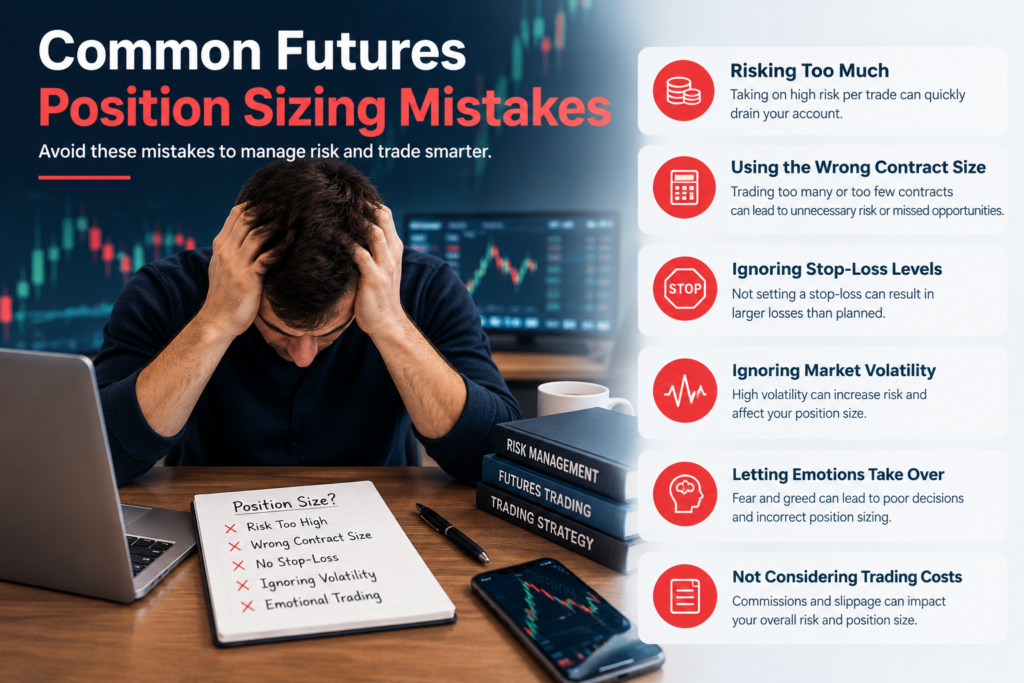
Common Futures Position Sizing Mistakes
Even when traders understand the formula, a few common mistakes can undermine their risk management.
Choosing Contract Quantity Before Setting a Stop
Some traders decide how many contracts they want to trade before calculating the risk. They then place a stop-loss that fits their preferred position size.
This reverses the logical process. A better approach is to determine the trade setup and appropriate stop-loss first, then calculate the contract quantity that fits the risk budget.
Rounding Up Instead of Down
If a calculator returns 1.8 contracts, rounding up to two can push the planned risk above the selected limit.
Always round down when calculating the maximum whole-contract quantity under a risk cap. If one contract still exceeds your risk budget, consider whether a smaller contract is available or whether you should skip the trade.
Ignoring Trading Costs
A calculation that excludes fees and slippage may underestimate the cost of a trade. This becomes particularly important for strategies involving frequent entries and exits.
Use realistic estimates for your broker, contract, and execution conditions, and understand that actual costs may differ.
Confusing Margin With Risk
Having enough margin to open a position does not mean you can afford the potential loss. Margin requirements and trade risk should be evaluated separately.
Increasing Position Size After a Loss
Increasing contract quantity to recover a previous loss can create a cycle of escalating risk. Position sizing should follow a consistent plan rather than emotional reactions to recent results.
Frequently Asked Questions
What Is a Futures Position Size Calculator?
A futures position size calculator is a tool that estimates how many futures contracts fit within a trader’s planned risk budget. It typically uses account balance, risk percentage, stop-loss distance, and contract tick or point value.
Some calculators also include commissions, slippage, and margin estimates. The result is a planning estimate, not a guarantee of the maximum loss.
How Do I Calculate Position Size in Futures Trading?
First, calculate your risk budget by multiplying your account balance by your chosen risk percentage. Next, calculate the dollar risk per contract using your stop-loss distance and the contract’s tick or point value.
Finally, divide your risk budget by the risk per contract and round down to the nearest whole contract. Include estimated trading costs when possible.
Why Is Position Sizing Important in Futures Trading?
Position sizing helps control exposure, maintain consistent risk limits, and prevent a single trade from taking up too much of your account’s risk budget.
It also allows traders to compare setups using the same framework. However, proper position sizing cannot eliminate losses or guarantee profitability.
How Does Risk Percentage Affect Position Size?
A higher risk percentage increases the amount available for planned trade risk, potentially allowing more contracts. A lower risk percentage reduces the risk budget and may reduce the maximum contract quantity.
For example, a 1% risk budget on a $10,000 account is $100, while a 0.5% risk budget is $50. The appropriate percentage depends on the trader’s circumstances and strategy.
What Is Point Value in Futures?
Point value is the dollar amount associated with a one-point movement in a futures contract. It is determined by the contract’s specifications.
For example, ES has a $50 point value, while MES has a $5 point value. Always verify the contract multiplier for the instrument you are trading.
What’s the Difference Between Points and Ticks in Futures Trading?
A point represents a full unit of price movement, while a tick is the minimum permitted price increment for a contract.
For ES and MES, one point equals four ticks because the tick size is 0.25 points. Their tick values differ because their contract multipliers are different.
How Many Contracts Should a Beginner Trade?
There is no single contract quantity that suits every beginner. The answer depends on account size, stop-loss distance, contract value, risk tolerance, and available margin.
Calculate your risk per contract before deciding. If one contract exceeds your risk budget, a smaller contract or no trade may be more appropriate.
Why Should I Use the Position Size Calculator Before Each Trade?
Market conditions, entry prices, stop-loss distances, and trading setups can change from one trade to another. Calculating position size before each trade helps keep planned risk consistent.
It also reduces the likelihood of choosing a contract quantity based on emotion or an arbitrary target.
Does a Futures Position Size Calculator Include Margin?
Not every calculator includes margin. Some focus exclusively on planned trade risk, while advanced tools may estimate the margin required for a position.
Check the tool’s features and confirm current requirements with your broker. Margin availability does not determine how much you should risk on a trade.
Can My Actual Loss Exceed the Calculated Risk?
Yes. The calculated amount is generally an estimate based on the intended stop-loss price and contract specifications.
Slippage, gaps, fast market movements, commissions, and execution delays can cause the actual loss to exceed the estimate. A stop-loss order does not guarantee execution at its specified price.
Final Thoughts
A Futures Position Size Calculator can help you make more consistent trading decisions by connecting your account balance, stop-loss distance, and risk budget to a practical contract quantity.
Before entering a trade, verify the contract specifications, calculate the risk per contract, account for trading costs, and check the margin requirements. Avoid increasing your position simply because a broker allows it or because you want to recover a previous loss.
The objective is not to find the largest position you can open. It is to understand the risk you are taking and determine whether that risk fits your trading plan.
Risk Disclaimer: Futures trading involves substantial risk and may not be suitable for every investor. You can lose more than your initial margin or planned risk amount. Calculator results are estimates for educational purposes and should not be treated as financial advice or a guarantee of future results.

- Best Futures Position Size Calculator: Calculate Trading Risk - October 23, 2026
- How to Use Canva: 7 Easy Steps for Beginners - October 19, 2026
- How Much Is DEF Per Gallon in 2026? Best Prices & Savings - October 16, 2026